
Plan to execute
Define production orders, work orders, schedules, material identifiers and BOM information that execution needs.
Planning & execution data exchange
VEERA’s ERP + MES integration approach connects enterprise planning information with manufacturing execution and production feedback.
Request a demo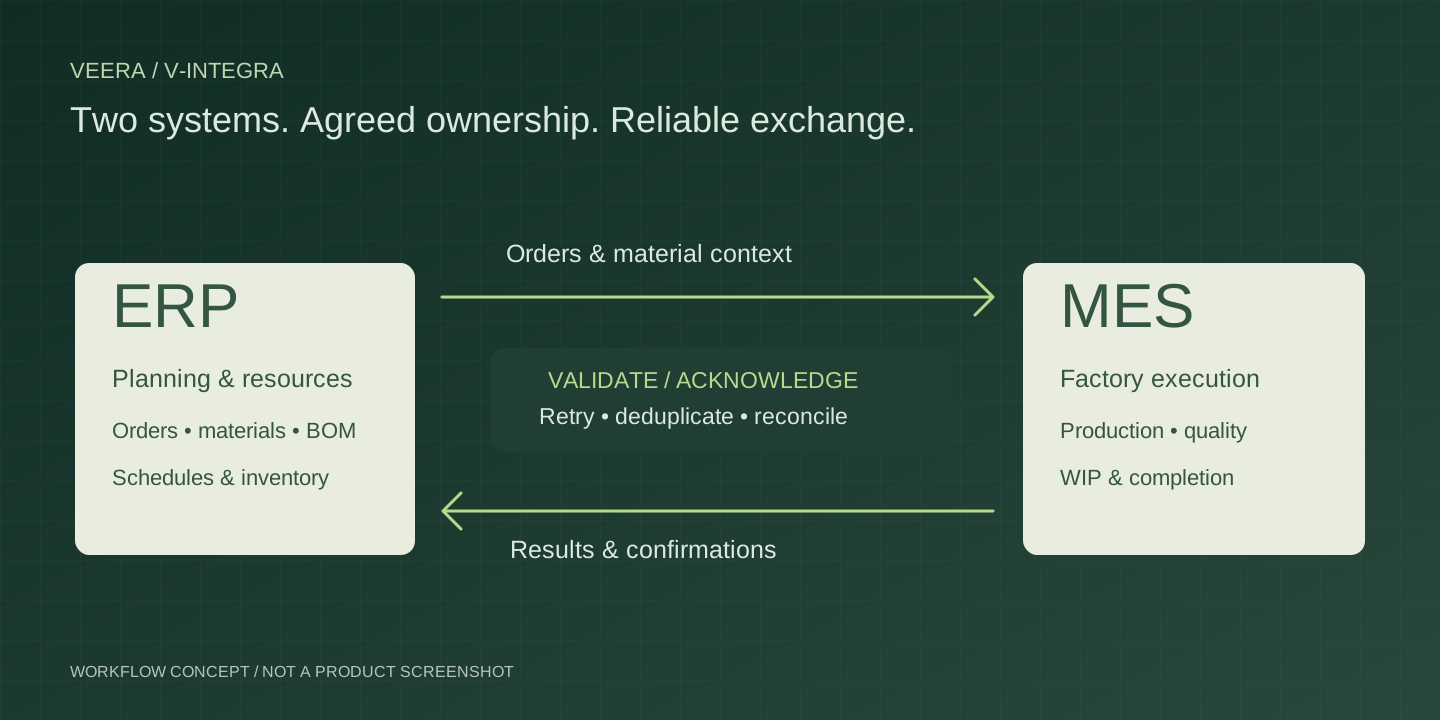
WHO IT IS FOR
For manufacturing IT, production planning and operations teams connecting ERP records with shop-floor execution.
An ERP can hold the plan while the factory works from a separate version of it. Manual re-entry and delayed confirmations create uncertainty about material, work in progress and what has actually been produced.
SOLUTION SCOPE
Define production orders, work orders, schedules, material identifiers and BOM information that execution needs.
Map production and rejection quantities, WIP, quality information and finished-goods confirmations back to planning.
Agree on source ownership, identifiers, validation rules, duplicate handling and reconciliation reports.
Design around available ERP APIs, approved database access, files or other supported integration mechanisms.
HOW IT WORKS
Agree on identifiers, fields and system ownership.
Send orders and return production results through approved interfaces.
Check required fields, duplicates and acknowledgements.
Resolve exceptions and compare records at both ends.
Workflow, supported features and deployment requirements are agreed for your implementation.
PLAN YOUR DEMONSTRATION
Document data ownership, supported interfaces, exchange direction, frequency and exception handling. Test duplicate messages, partial completion and recovery from connection loss before expanding the integration.
ERP primarily manages enterprise resources and planning. MES provides execution context and visibility on the manufacturing floor. Integration exchanges the agreed information between them.
No specific ERP connector is claimed here. VEERA assesses available APIs, approved databases, file exchange and the ERP vendor’s integration requirements before confirming scope.
It can be designed to exchange planning information and production feedback where both systems support it. Direction, frequency and ownership are agreed for each data object.
An integration design should specify validation, retry limits, duplicate prevention, exception ownership and reconciliation. These controls must be verified during acceptance testing.
DISCUSS YOUR REQUIREMENTS
Share your process, current systems and priorities. Talk to VEERA